2026-09-01 ·
Dealing with Low Voltage Issues in Remote Prineville Locations
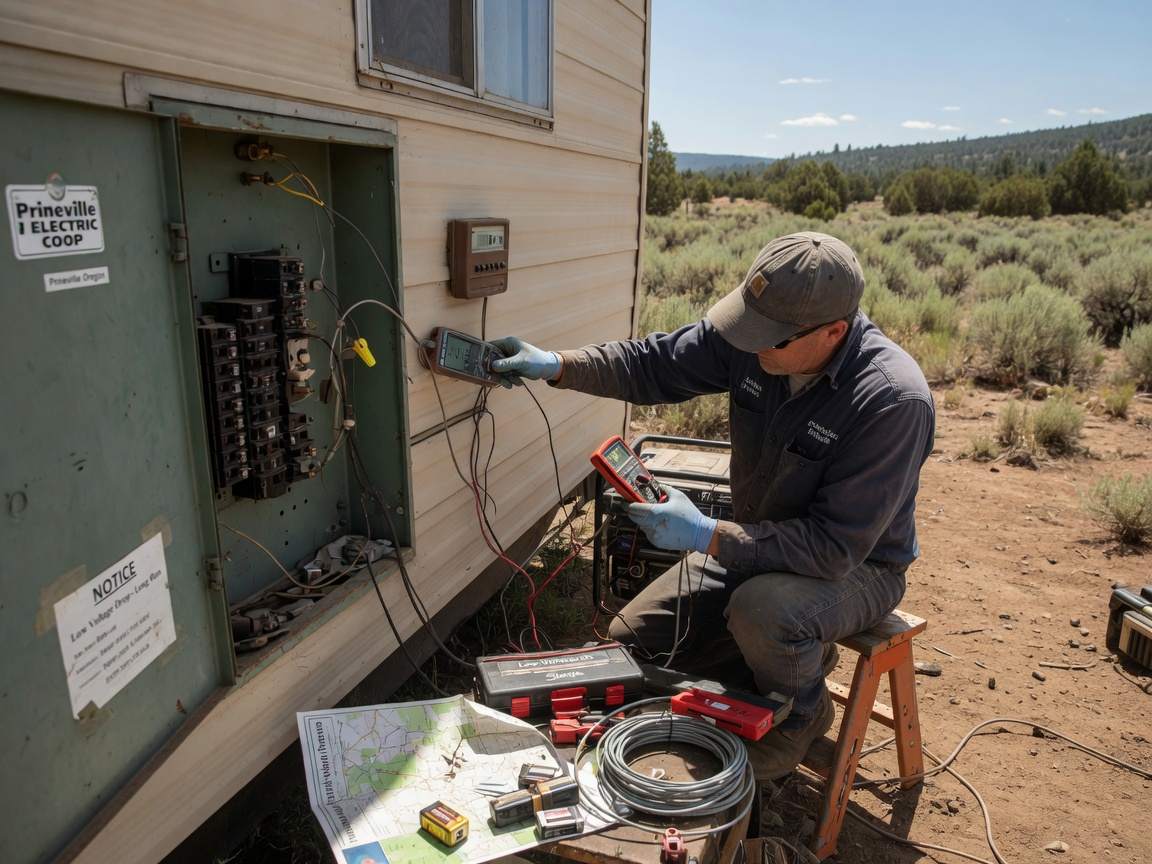
Low voltage problems on remote Prineville properties are caused by voltage drop over long wire runs, corroded or loose connections at junction boxes, and undersized conductors that were never meant to carry a load 200-400 feet from the main panel — and fixing them usually costs $250-$1,200 depending on how much wire has to be replaced. Out on properties toward Powell Butte, Terrebonne, or the acreage bordering Ochoco National Forest, it's common to find shops, wells, and barns wired decades ago with wire gauge that was adequate for a light bulb but chokes under a modern shop compressor or well pump. Add Crook County's high desert swings — hot, dry summers followed by hard winter freezes — and connections that were marginal to begin with start failing outright.
Why Remote Properties See More Low Voltage Trouble
Distance is the biggest factor. Every wire run has resistance, and the longer the run, the more voltage gets lost before it reaches the load. A well pump or shop panel fed by a 250-foot run of 10-gauge wire that was fine for a small load can drop 10-15% by the time it reaches the equipment, enough to cause motors to hum, lights to dim, or breakers to trip nuisance-style. This shows up constantly on the outskirts of Prineville and toward Terrebonne, where outbuildings sit far from the main service and were often wired as an afterthought rather than sized for the actual distance and load.
Add in Crook County's climate and the problem compounds. Summer heat around 90-100°F causes wire insulation and connections to expand, while winter lows well below freezing contract everything back down. That constant cycling loosens wire nuts, splice connections, and lug screws inside junction boxes and subpanels — especially ones mounted in uninsulated shops or pump houses that see the full swing of outdoor temperatures. A connection that was snug in July can be loose enough to arc or drop voltage by January.
Common Signs of Low Voltage on a Property
- Dimming or flickering lights when a well pump, compressor, or motor starts up
- Motors that hum, stall, or overheat instead of running at full speed
- Breakers tripping intermittently with no clear load spike
- Slow-running well pumps or reduced water pressure tied to electrical timing rather than the pump itself
- Warm or discolored outlets and panel lugs, a sign of resistance heating at a bad connection
- Electronics resetting or GFCI outlets tripping during equipment startup
Any of these on a detached shop, barn, or wellhouse usually points to either an undersized feeder or a failing connection somewhere along the run, not a problem with the equipment itself.
How We Diagnose It on Site
Diagnosing low voltage isn't guesswork — it's a process of elimination with a meter. We start by measuring voltage at the main panel under load, then at the subpanel or outbuilding feed, and compare the drop against the wire gauge and distance. A drop of more than about 3% for branch circuits or 5% total from service to load is a red flag worth chasing down. From there we check:
- Panel and subpanel lugs for corrosion, discoloration, or looseness
- Splice points in junction boxes along the run, especially any buried or exterior boxes exposed to moisture
- Wire gauge versus distance and amperage, using standard voltage-drop calculations rather than guessing
- Grounding and neutral connections, since a poor ground can mimic low voltage symptoms
On older Prineville properties, especially those near downtown with original 1960s-70s wiring, we often find aluminum branch wiring or backstabbed connections that were never great to begin with and have only gotten worse with age and temperature cycling.
Fixes That Actually Solve the Problem
Once the cause is identified, the fix depends on where the drop is happening:
- Undersized feeder wire: upsizing the run, sometimes from 10-gauge to 6-gauge or larger depending on load and distance, resolves chronic drop for good
- Bad connections: cleaning, re-torquing, or replacing corroded splices and lugs, often inside a circuit breaker panel that's due for a broader inspection anyway
- Undersized subpanel: an electrical panel upgrade at the outbuilding end can stabilize voltage for shops running welders, compressors, or multiple motors
- Aging branch wiring: full rewiring of the affected run when insulation is cracked or conductors are undersized throughout
Patching a single bad connection is a same-day fix in the $150-$400 range. Upsizing a long feeder run to a detached shop or barn is a bigger job, often $800-$2,500 depending on trench length and whether it's overhead or buried, but it's the only permanent fix when the wire itself is the bottleneck.
Planning Around the High Desert Climate
Anyone with a shop, well, or barn out toward Culver, Metolius, or the Ranch area should plan electrical work around Crook County's seasonal extremes rather than against them. Connections exposed to direct sun and 100°F summer days need proper weatherproof boxes and connectors rated for the swing, not standard interior hardware. Buried feeder runs should sit below frost depth so ground movement during freeze-thaw cycles doesn't stress the cable jacket over the years. If a property also relies on a backup generator during winter outages, it's worth reading up on safe generator use during Prineville power outages, since a generator feeding an already voltage-starved subpanel will only mask the underlying wiring problem rather than fix it.